


Chestnut
A chestnut is reddish-brown, with mane and tail the same shade or lighter, never black.
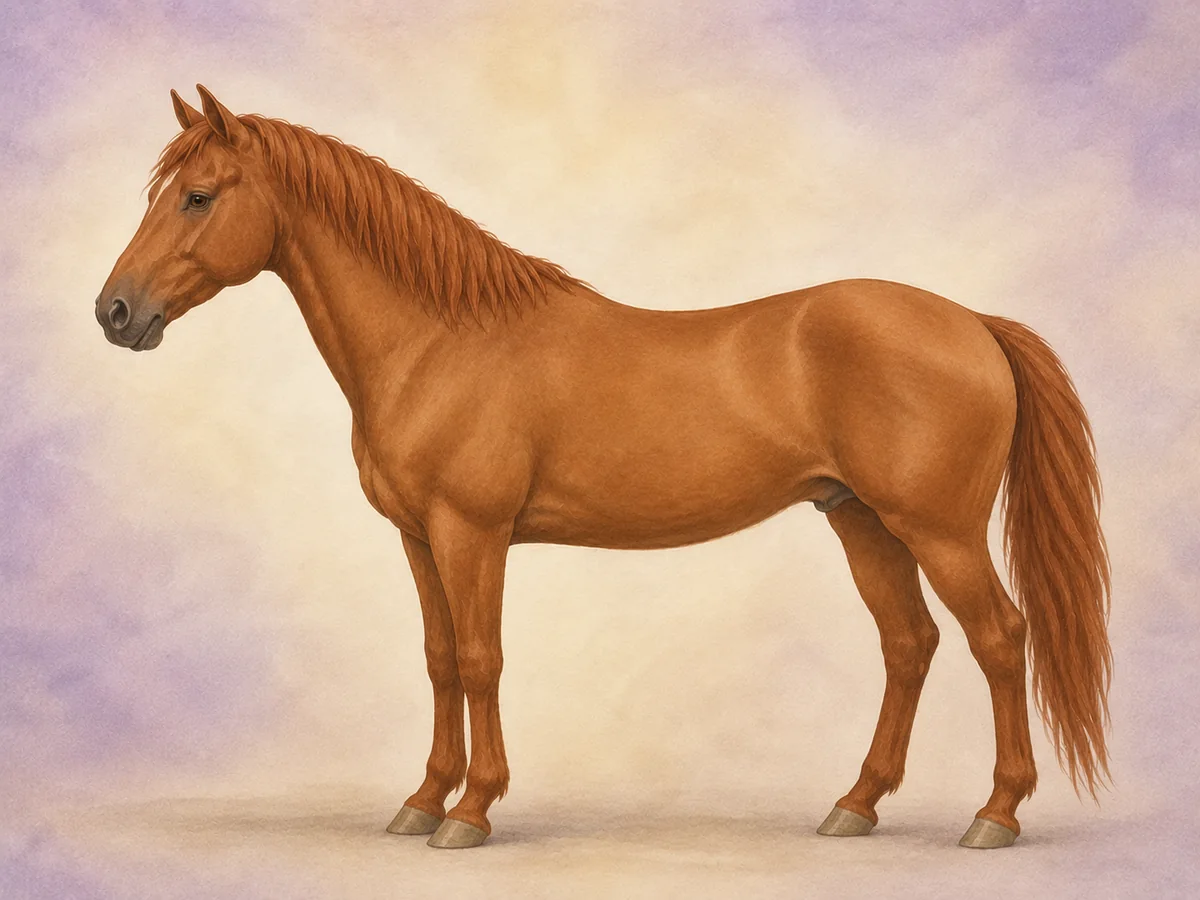
What does this colour look like?
A reddish-brown body, from light copper to deep red-brown. Mane, tail and legs are just as red or lighter, never black.
- Body
- red to reddish-brown
- Mane and tail
- red, sometimes lighter (flaxen)
- Legs
- red, no black
- Skin
- dark
- Eyes
- brown
How does this colour arise?
A chestnut makes only red pigment. So there is no black anywhere in the coat.
More about the genetics
Chestnut arises from two recessive e alleles at Extension (MC1R): e/e (or the rare ea). Without functional MC1R only red pigment (pheomelanin) is made. Agouti plays no visible role, as there is no black to distribute.
What is this colour often confused with?
- Liver chestnut
A very dark, chocolate-brown chestnut.
- Bay
A bay horse has a brown body with black mane, tail and lower legs.
- Flaxen chestnut
A chestnut with strikingly light, almost blonde mane and tail.
- Palomino
You recognise a palomino by its golden coat with light, almost white mane and tail.
Does the colour change?
Little; some seasonal variation. The summer coat can look lighter and bleached.
Which breeds show this colour?
Discover more
Sources: UC Davis Veterinary Genetics Laboratory · Sponenberg, D.P. & Bellone, R.R. (Wiley-Blackwell).